You’re never too far from a snake.
— Tyson Yunkaporta, Snake Talk
This essay is about a qualifier. Four words long, taught in every thermodynamics course, and almost always gone by the time the idea reaches daylight.
Here is the law with it:
The entropy of an isolated system never decreases.
And here is how the idea usually arrives:
Entropy always increases. Everything runs down.
The four words that went missing are of an isolated system. They are not decoration. They name the only kind of system the sentence is true of — and almost nothing you will think about today is one.
What the loss produces is a picture of the universe as a thing winding down like a clock, and that picture has been doing work far outside physics for a very long time.
The person who put it to us most sharply is Tyson Yunkaporta, of the Apalech clan, western Cape York, a Wik Mungkan speaker who writes about knowledge systems. His charge is not that our physics is wrong. It is that we took a true law and sang it somewhere it does not belong, and that the consequences have been enormous.
Two things this essay will not do. It will not explain the Rainbow Serpent, which is not one being, not one nation’s, and not ours to describe. And it will not claim that Aboriginal Law is validated by thermodynamics — that would make our instruments the judge of somebody else’s jurisprudence, which is the argument in Already an Entity (No. 81) and we are not going to undo it a week later. What it will do is take a criticism of our physics, from outside our discipline, and check it.
Three times we walked up to this and stopped
Before anything else, the confession, because it is what gives this essay its subject.
The Elimination of Waste (No. 43) follows the word waste from Carnot’s heat engine into scientific management and then into the school. On its last spread it stops dead and argues against itself: “you are not a heat engine. The second law governs closed systems and cyclic processes; a person is neither. Fatigue is not waste heat, spoons are not joules.” It marks that step as its leap and declines to take it.
The Noise Floor (No. 56) uses the same law in the other direction — Nyquist deduced the thermal noise floor from the second law, because a silent resistor would be a perpetual-motion machine. The hiss is not a shortfall. It is required.
Your Shadow Is the Centre (No. 69) establishes that a rainbow is a cone of directions with its apex in your own eye: there are as many bows as there are observers, and Roger Bacon reasoned his way to it around 1267 with an astrolabe and a measured 42°.
Three pieces, three edges of one argument, and each of them stops just short of it.
Yunkaporta does not stop. He puts the three together and says the arrangement is a curse.
The qualifier, stated properly
Thermodynamics distinguishes three kinds of system, and the distinction is not pedantry — it decides which sentence is true.
| System | Exchanges with its surroundings | What the second law says about its entropy |
|---|---|---|
| Isolated | neither matter nor energy | tends to a maximum, and does not decrease |
| Closed | energy but not matter | can decrease, given work or energy input |
| Open | both matter and energy | can decrease, while entropy production inside stays non-negative |
The familiar sentence — entropy always increases — is true of the first row only. Conflating closed with isolated is a well-documented error, and it is the one that matters here, because almost nothing anybody cares about is isolated.
Both statements are written down, side by side, in a review of exactly this subject in Reviews of Modern Physics. Martin Singh and Morgan O’Neill give the restricted form first:
Look at where the qualifier is. It is not in a footnote or a preamble. It is printed as a parenthetical label on the equation itself — (isolated system) — because the equation is not true without it. And their definition is the strict one: “an isolated system… does not exchange mass or energy with its environment.”
Then, four paragraphs later, they say the climate system exchanges energy with space as radiation “and it is therefore not isolated,” and give the general form:
That is the whole thing in two lines. The law is not weaker out here. It has one more term. Entropy produced inside is still never negative — the second law is intact and unnegotiable. But a system that exports entropy faster than it makes it can have its own total entropy fall, and no law is broken.
Read the No. 43 sentence again: “the second law governs closed systems and cyclic processes.” The precise word is isolated, and ours was loose.
Yunkaporta uses both words, and where he puts each one is worth noticing. Naming the thermodynamic term he writes closed system, which is the ordinary shorthand and what most physics writing says. But describing what the worldview actually demands, he writes: “systems must be isolated and exist in a vacuum of individual creation.” That is exact. Isolation is the stronger condition, it is the one the doctrine requires, and he uses the stronger word in the place where it belongs.
So this is a correction to us, not to him.
It is how anything alive works. A seed does it. A forest does it. You did it this morning.
The Earth is not isolated. It receives a stream of low-entropy sunlight and radiates high-entropy infrared to space, and it is that gradient — not any exemption from physics — that pays for every ordered thing on the planet.
Running through, not down
If the running-down picture is the wrong one, the obvious question is what the right one is. There are two answers, at two scales, and they are not the same answer. Keeping them apart matters.
The first is ours, and it is not in dispute. Singh and O’Neill open their review by stating it plainly: “The Earth is a highly irreversible thermodynamic system. It receives energy and entropy from the sun and radiates energy and entropy to outer space.”
What arrives is a focused beam of shortwave radiation with an effective emission temperature of about 6,000 K. What leaves is diffuse longwave emission at about 250 K. The energy in and out are, in their words, “roughly in balance” — the planet is not hoarding it. What changes is the entropy those photons carry:
That difference is the entire budget out of which every ordered thing here is paid: a forest, a reef, a body, a sentence, this page.
The planet is not running down. It is running through.
The second answer is Yunkaporta’s, and it is about time rather than energy. This is where the disagreement he is describing actually sits, and it is worth having in full rather than in summary:
Read that against the four missing words and the shape of the thing is plain. The linear model is not a finding about time. It is what you are left with once you have assumed isolation — because an isolated system really does have a beginning, a middle, and an end, and really does run down. Assume the box, and the arrow follows. What Yunkaporta is pointing at is that the box was assumed.
He pairs his own First Law with the first law of thermodynamics himself, and directly: “First Law always means nothing is created or destroyed, but just keeps going around if you look after your place, whether you’re an Elder or a physicist.” That pairing is his and we report it as his. We are not offering thermodynamics as confirmation of anybody’s Law — that is the move refused below, and in No. 81 before it.
What we can say is narrower and still worth saying. Of the two models, one of them describes the planet we are on. Earth exchanges matter and energy continuously, in every direction, at every scale. The straight line requires a container that is not there.
A true law, sung where it does not belong
Here is the argument as Yunkaporta makes it. It is his, it is in print, and we are reporting rather than extending it.
He describes how a curse works in an Aboriginal worldview: you take part of a system, observe the pattern of the whole in that fragment, “then you sing a false pattern… into the whole from the part, powering it with another system in constant motion.” And then:
Note the precision of the definition. A curse is not superstition here and it is not a lie, necessarily. It is a true pattern, correctly observed, deliberately applied outside its domain, and powered by something that keeps moving. That is a description of a category error with a delivery mechanism — and as a description of what happened to the second law between the textbook and the culture, it is uncomfortably exact.
He goes further, and this is the part that is his interpretation rather than a physics claim: that the appetite for closed systems is why the built world is so full of “fences and walls, borders, great divides, and great barriers.” If your model of time requires an isolated system, you will find yourself manufacturing them.
We are not in a position to adjudicate that. We can say that the physics half is right, that our own No. 43 half-said it and stopped, and that the question he ends on is a fair one to leave standing:
A club that says two things depending on how you hold it
The argument has an object attached to it, and the object is the best short explanation of it.
Yunkaporta carved a club. Around its head he etched an ouroboros — the snake swallowing its own tail — to stand for the second law and a world that must end. But the club is three-dimensional, and when you roll it across clay the etching releases something the flat image could not hold: “an endless procession of snakes, head to tail.”
One carving. Rolled, it prints a line with no last snake in it.
The ouroboros closes because something is being consumed. The procession does not close, and nothing is eaten.
That is the first law and the second law rendered as a tool you can hold, and it is worth saying plainly that this is a better teaching object than most of the diagrams in a physics textbook. It also carries his sharpest line about the figure itself, from earlier in the same book: the ouroboros was supposed to be a metaphor for infinity, “However, it contained the same curse, the same contradiction: How can this serpent be a symbol of infinity if it will eventually eat itself?”
The bow was always a circle
One piece of pure physics, which belongs to nobody, and which this site has already worked over twice.
A rainbow is not an arc. It is a cone of directions, roughly 42° from the antisolar point, with its apex at your eye. You see an arc because the ground cuts the cone. From an aircraft, with nothing in the way, the same bow is a complete circle — and it always was.
Which means the bow moves when you move, and two people standing on two hills are not looking at one rainbow from two angles. They are looking at two rainbows. Yunkaporta makes exactly this point, and reaches the same conclusion an optics textbook does:
We are not claiming a convergence here, and we are certainly not claiming that physics confirms anything. It is one fact about light, available to anyone who looks, and two traditions noticed it. That is what a fact about light is like.
The full argument, with Bacon’s astrolabe and the reason there are as many rainbows as there are observers, is Your Shadow Is the Centre. The catalogue of every other kind of bow is A Field Guide to Rainbows.
Not one serpent
This is the section where the essay stops.
The Rainbow Serpent is not a single figure with regional variants, and treating it as one is the specific error this site has undertaken not to make. There are many beings, many nations, many names, and some of the knowledge is restricted. Yunkaporta says so himself, of the serpent he is describing: “There are infinite variations of him in all shapes and sizes throughout the world—wyrm, dragon, uraeus, and many different names in different regions, taking the shape of the spirit of those places.”
So: quoted, credited, and not explained. We are not going to summarise a Law we do not hold, or produce the tidy paragraph that would let a reader think they now know what the Rainbow Serpent is.
Not squeamishness. The Rainbow Serpent has one of the heaviest histories of commodification in Australian art — reproduced on tea towels and airport canvases for decades, usually without a nation attached and usually without payment. A settler-run project adding one more explanation to that pile is not a contribution.
What we can do instead is the boring thing: cite the person, name the clan, quote rather than paraphrase, and link out.
The head does not take the tail
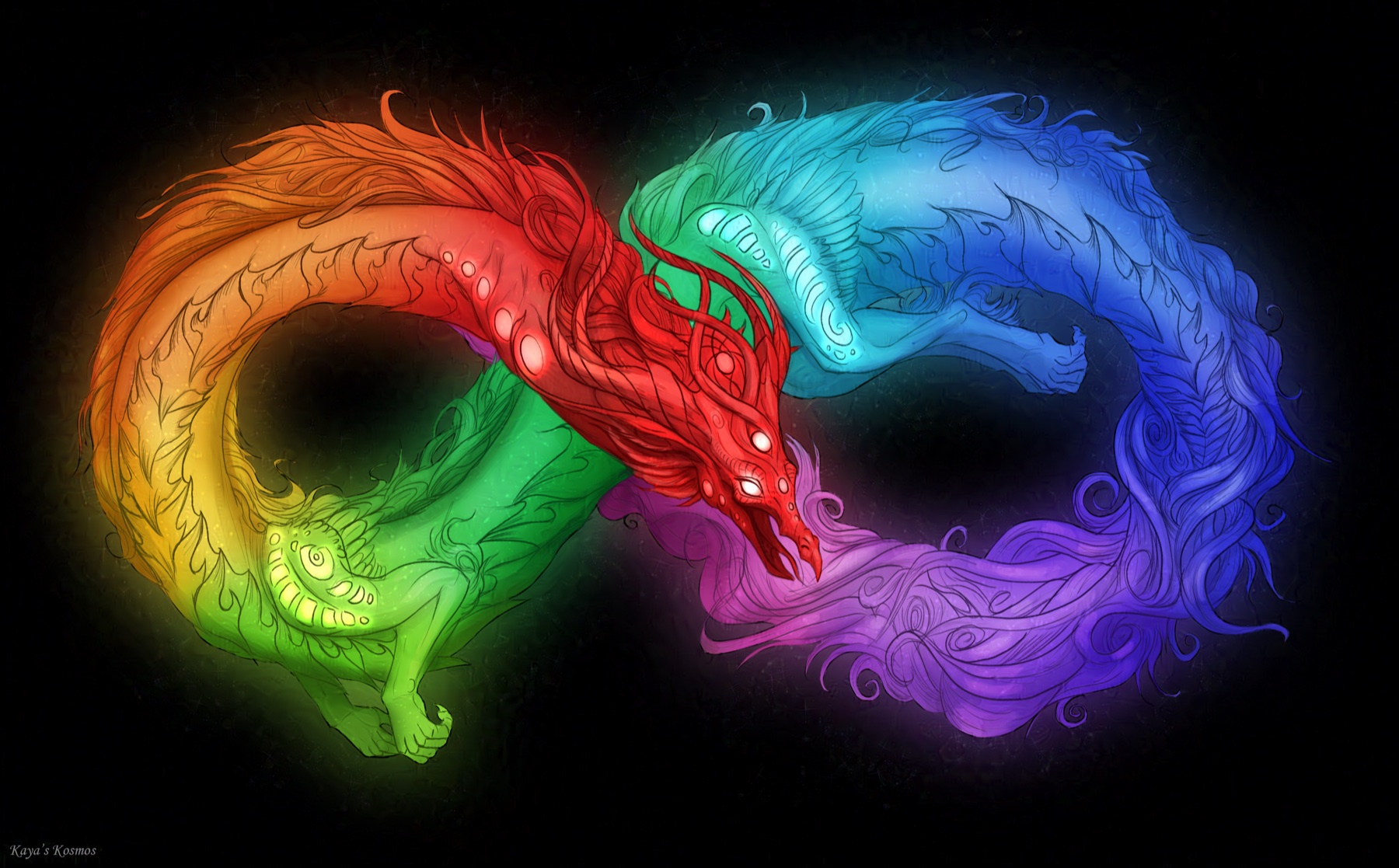
This is the autistic community’s own infinity symbol, drawn as a dragon by an autistic artist for whom dragons are a long-standing special interest — and drawn, in her words, “to represent the influence my autism has on my art.” Kaya Oldaker also drew Esmx, the Stimpunks mascot.
It belongs in this essay for a reason that is about geometry, and that you can check by looking at the picture.
Look at the crossing point. The mouth is open, and the violet plume of the tail passes beneath and past it. Nothing is gripped and nothing is being consumed. This is a lemniscate — a single continuous curve that crosses itself and carries on — and a lemniscate is not an ouroboros. An ouroboros closes by eating.
The ouroboros is an isolated system. The infinity loop is an open one. The difference is whether anything has to be eaten for the figure to continue.
We are not going to claim Kaya drew a thermodynamics diagram. She drew a dragon, for a reason she has stated, and it is a better dragon than the argument needs. But the autistic community chose an unclosed figure for itself, and the distinction between the figure that closes and the figure that does not is exactly the distinction on the club.
This essay has just spent a section on Rainbow Serpents and then shown you a rainbow-coloured serpentine figure a few hundred words later. That juxtaposition does work whether we intend it or not, so: the resemblance is an artefact of our running order.
Kaya’s dragon is not a Rainbow Serpent, is not descended from one, and is not answering to one. It is an autistic artist’s symbol for autistic people, and the only reason the question comes up at all is that we put the two things near each other. That is ours to manage, not hers to disclaim. They rhyme, and rhyming is not descent.
A deficit assessment is an isolated-system model of a person
Here is the one claim in this essay that is ours, about us, made with our own symbol, and routed nowhere near anybody’s Law.
An assessment measures a person alone. It scores them against a standard, in a room, on a day, with the environment held constant and unrecorded. Whatever comes out is treated as a property of the person — something they have, or lack, or are losing.
That is an isolated-system model, and people are not isolated systems. The support in the room, the noise, the lighting, whether anyone believed you last time, whether you are allowed to move — all of these cross the boundary constantly, and none of them appear in the score. When the number comes back low, the model has nowhere to write down that half the apparatus was outside the box.
Nothing in thermodynamics licenses that observation. The physics does not say how anybody should be treated, here or anywhere — that argument is A Promise, Not a Finding, and it holds. Down to is not because of.
What the physics does is take away an excuse. If you are going to model a person as a system, you have to say which kind, and if you say isolated you are wrong before you have measured anything.
What this essay is not
- Not an explanation of the Rainbow Serpent. Quoted from a named author of a named clan, and left there. It is not one being and we do not hold it.
- Not Aboriginal Law validated by physics. The traffic here runs the other way: a criticism of our physics, arriving from outside our discipline, which we checked and found correct. See No. 81 for why the reverse would be a colonial move with better manners.
- Not a claim that the second law is wrong or optional. It is exactly right, in its domain, and No. 56 is built on it holding. Entropy production in an open system is still never negative.
- Not “the second law proves rest is mandatory.” No. 43 refused that on its own last spread and we are not un-refusing it. You are not a heat engine, and spoons are not joules.
- Not a lineage. The ouroboros, the Rainbow Serpent and the autism infinity loop are three different things that happen to be snakes bent into curves. They rhyme. Rhyming is not descent, and noticing a rhyme is not discovering a connection.
- Not ancient wisdom. Yunkaporta is a working academic who published a book in 2019 and an essay in a magazine. Filing living argument under timeless folklore is another way of filing it under not-current.
Coda: processes rather than objects
The last word should be his, unglossed. Speaking about serpent law, in conversation rather than in print:
We are not going to interpret that. But it is worth saying where it lands against everything above, because it lands squarely.
An isolated system is a thing. An open system is a process. That is the entire content of the two equations: one describes a box with contents, and the other describes a flux — a rate, terms crossing a boundary, a quantity defined by what passes through it rather than by what it holds. dS/dt = Še + Ši is not a description of an object. It is a description of a process, and it has a boundary in it that you had to choose.
Which is also the whole of the deficit assessment. A score is an object. A person is a process, with edges that bleed by design — and the assessment’s error is not that it measures the wrong thing but that it measures a thing at all.
Sources, and what we did not read
Yunkaporta, Tyson. Sand Talk: How Indigenous Thinking Can Save the World (2019) — pp. 44–49, quoted from the edition held by Ryan Boren: the curse definition and the second-law passage, the ouroboros and the rolled procession, the “infinite variations of him” passage, and the ouroboros contradiction. “A rainbow serpent theory of time,” Garland Magazine — confirmed as Yunkaporta and described there as an edited extract from Sand Talk; the two versions differ in wording, and the standpoint passage is quoted from the Garland text and labelled as such. “You’re never too far from a snake” is from his Snake Talk yarn, at 2:30 in the recording — timestamped by Ryan Boren, and quoted from the video rather than from a transcript. The coda is from “Unlocking the Power of Indigenous Knowledge with Tyson Yunkaporta”, likewise transcribed from speech: a false start is elided at the opening and the punctuation is ours, since spoken language does not carry any. No word has been changed, added or reordered, and the spelling is the transcript’s rather than this site’s. The thermodynamics is from Singh, M. S. & O’Neill, M. E. (2022), “The climate system and the second law of thermodynamics,” Reviews of Modern Physics 94(1), 015001, doi:10.1103/RevModPhys.94.015001 — read directly, open access as arXiv:2102.01745. It is the source of eq. (1) with its (isolated system) label and the strict definition that such a system “does not exchange mass or energy with its environment”; of eq. (3), dS/dt = Še + Ši with Ši ≥ 0, for non-isolated systems; of the statement that the climate system exchanges energy with space as radiation “and it is therefore not isolated”; of “the Earth is a highly irreversible thermodynamic system” and “the Earth exports vastly more entropy than it receives”; and of the ~6,000 K and ~250 K emission temperatures. They in turn cite de Groot, S. R. & Mazur, P., Non-Equilibrium Thermodynamics (Dover, 1984) for both forms, which is the standard textbook behind them and which we have not read. An earlier version of this essay gave these from teaching sources; that was the piece’s first open item and this replaces it. Kaya Oldaker, The Autism Infinity Dragon — public domain per the artist’s own statement at Kaya’s Kosmos, quoted above. Note a live discrepancy worth fixing upstream: stimpunks.org/together/ currently attributes the drawing as CC BY-NC 4.0, which is more restrictive than the release the artist announced. Stimpunks is outside this repository, so the correction is handed on rather than made here. Ours, and marked as ours: the observation that Nos. 43, 56 and 69 each stop at an edge of this argument; the correction of our own “closed” to “isolated”; the reading of the dragon as a lemniscate rather than an ouroboros; and the isolated-system account of a deficit assessment. None of these is Yunkaporta’s and none should be attributed to him.
The universe doesn’t pathologize its own variation. And the running-down story is not a fact about you, a community, or a forest — it is a fact about a box that exchanges nothing with anything, and nothing you care about is that box. Heat death is real, and it is cosmology. It is not a description of your Tuesday.